

5. The puzzle
The puzzle
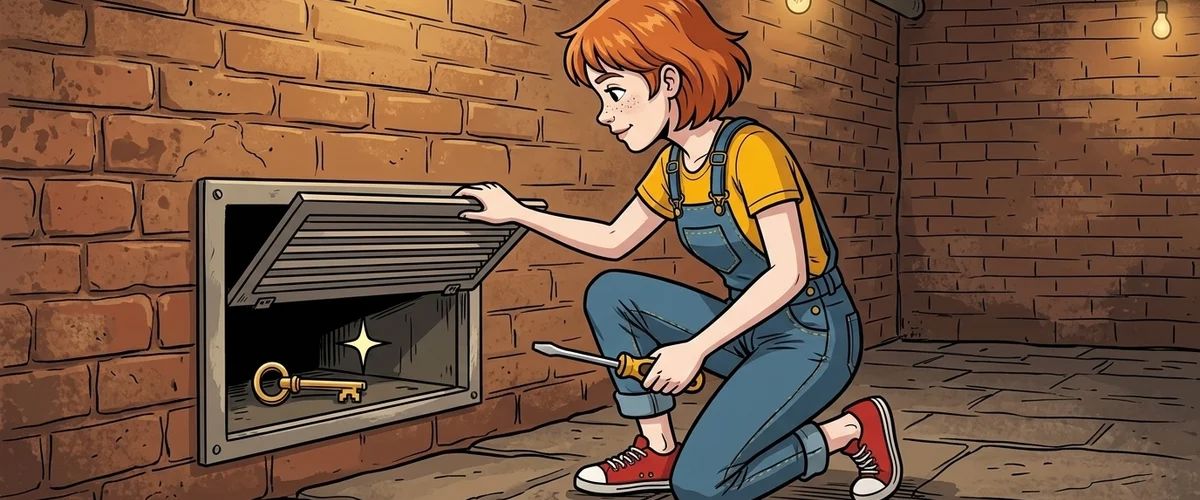
Now you connect the chain from chapter 1. Every step is an action, and a condition remembers what has already happened.
Step 1: open the grate
In the "screwdriver on grate" action from chapter 4:
- "Display text": "A few turns ... and the grate is off. There's something in there!"
- "Change condition": set
grate_opento true - "Add/Remove item": add the key to Pia
If you have an image of the open grate, create it as an object of its own and link it to grate_open. Then the change is visible.
Step 2: the answer changes
What happens if the player looks at the grate again after opening it? With the "If condition" action part you give a different answer depending on the state:
If grate_open is true:   "Empty. I already have the key."
Else:                    "The screws look loose."
That is exactly what separates a living world from a stage set.
Step 3: the door
On the object door, an action for "use key", just like in chapter 4. It leads to the ending you build in chapter 7.
What makes a puzzle fair
- The goal is clear. The player knows they want to get through the door.
- There is a hint. "The screws look loose" points in the right direction.
- The solution is logical. A screwdriver opens a screwed grate, everybody gets that.
- Wrong attempts get a response. Anyone trying the screwdriver on the door should hear: "I can't unscrew the lock."
These points go back to Ron Gilbert. As early as 1989 he described in his essay "Why Adventure Games Suck" what frustrates players in adventures and how to avoid it.
Rule to remember
One condition per step of progress. And every solution needs a hint first.
Your task
Make the whole chain playable, plus a response for one wrong attempt. Test it.



